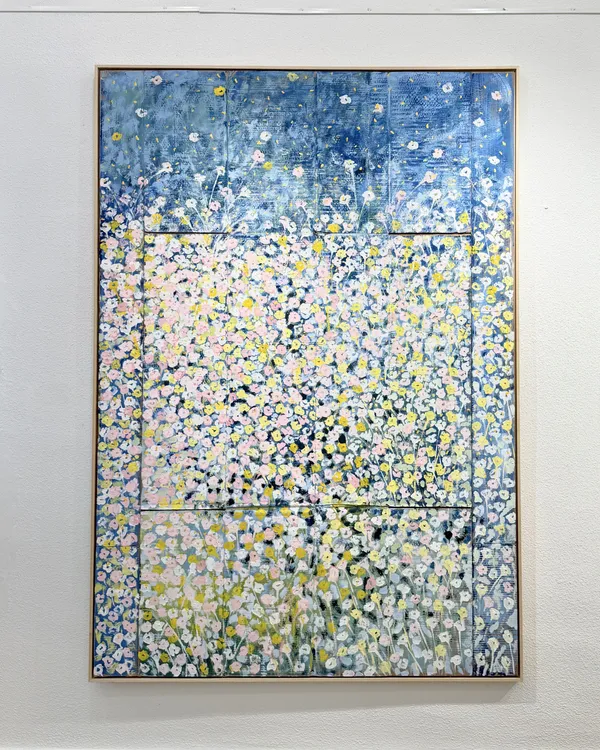
Forza Silenziosa: Sofia Cacciapaglia

MABE Gallery is delighted to announce the second solo exhibition of Sofia Cacciapaglia "Forza Silenziosa". In Sofia Cacciapaglia’s works, everything seems to whisper rather than assert itself. Forms slide, curl, and merge into one another in a fragile, almost secret balance. Nothing is fixed. Bodies transform into landscapes, gestures become rhythms, and female silhouettes emerge as presences that are both intimate and universal, unfolding within a space close to dream.
Her figures do not seek to occupy space, they inhabit it gently. Flowing hair, grazing hands, sketched gazes, these fragments compose a sensitive language in which emotion circulates freely. This circulation, almost invisible, gives rise to a contained force, a quiet energy that runs through each canvas. The feminine asserts itself here through an active softness, shaped by attention, connection, and presence.
With Forza silenziosa, Sofia Cacciapaglia explores a quiet form of power, one rooted in invisible connections, shared emotions, and natural cycles. Between figures and vegetal motifs, her works sketch a world where femininity unfolds through softness, and where silence carries a profound intensity.
In this exhibition, Sofia Cacciapaglia primarily paints on cardboard, which she collects in her neighborhood in Milan. It is through this practice that her work can be related to Arte Povera. Indeed, by using cardboard as an artistic support, a material considered “poor”, she aligns in part with this movement, theorized in the late 1960s by Germano Celant, which advocated the use of modest materials in reaction to consumer society and as a way of breaking with traditional artistic conventions.
Artists such as Michelangelo Pistoletto and Jannis Kounellis were already using elements from everyday life (objects, textiles, raw materials) in order to bring art closer to life and to question the systems of production and value within the art market. In this context, the cardboard used by Sofia Cacciapaglia can be understood as a support charged with a history of use, coming from an urban and commercial environment.
However, her work differs through its distinctly painterly approach. While Arte Povera often favored non-figurative forms, installations, or conceptual gestures, Sofia Cacciapaglia develops a figurative painting practice centered on flowers and female figures. She does not merely present the material; she transforms it into image.
Her work thus stands at the intersection of two traditions: on one hand, the legacy of Arte Povera, with its attention to materials and their context; on the other, a continuation of figurative painting, reintroducing narrative, sensitivity, and imagination.